


Processing times
Processing times
Release times and delivery methods
- Standard delivery: within 7 business days, sent via email in PDF format. The original paper document can also be sent by registered mail with return receipt.
- Urgent request: delivery within 3 business days via email in PDF format. If this timeframe is not met, the additional fee paid for urgency will be refunded.
- International delivery: upon request, the paper document can also be shipped via international courier.
The delivery times indicated are approximate and refer to the average processing time. We are not responsible for delays not attributable to our company.
Service description
Service description
Italian Birth Certificate online – no queues, no appointments
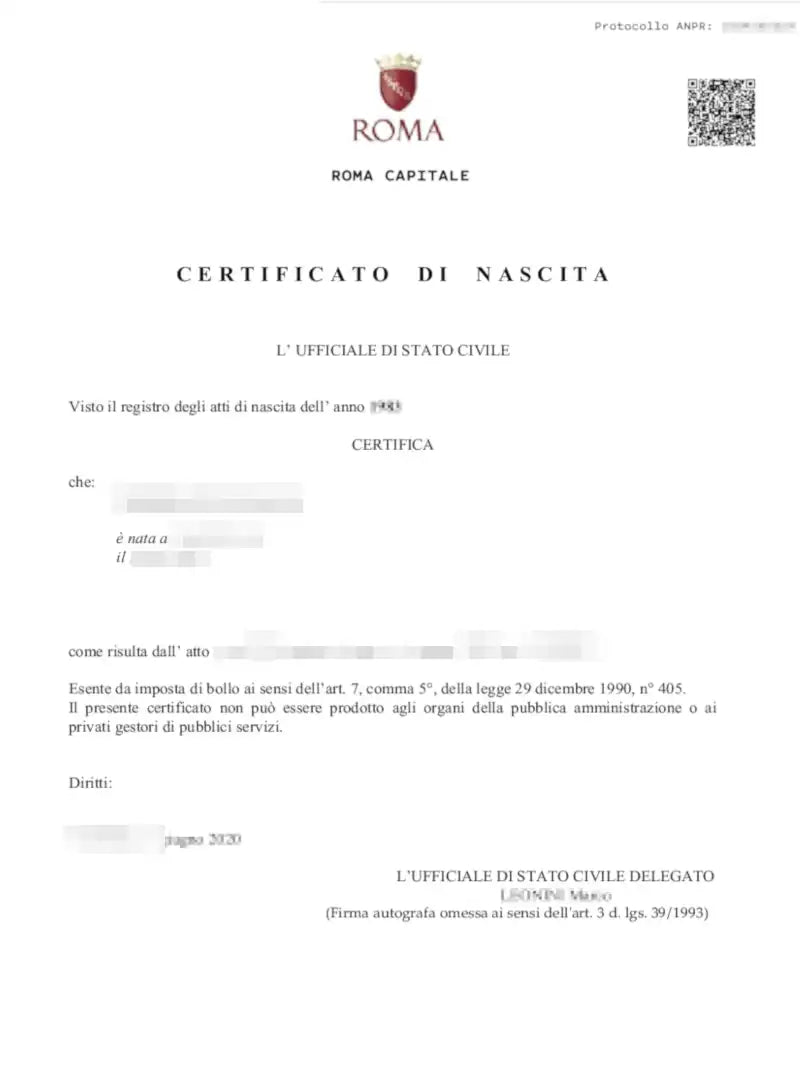
The Italian Birth Certificate online (Certificato di Nascita) is an official document issued by the Civil Registry Office of the Italian municipality where the birth was recorded. You can request it without visiting any office, directly from home or from abroad: we handle everything on your behalf via formal delegation.
What the document contains
The certificate includes: full name, date of birth, municipality of birth, and the signature of the competent Civil Registry Officer. It does not include the parents' details: if you need that information, the correct document is the Birth Extract (Estratto di Nascita).
Validity
The Birth Certificate is legally valid for 6 months from the date of issue. After this period, some authorities may require a newly issued copy.
Information required to place the order
To start the process, only three pieces of information are needed: the full name of the person the certificate refers to, their date of birth, and the Italian municipality where the birth was registered (usually the municipality of the parents' residence at the time of birth).
Who can request it
The certificate can be requested by anyone with a legitimate interest: the person themselves, a family member, a delegate, or a professional acting on behalf of a third party. Some municipalities may require a formal power of attorney accompanied by a copy of the subject's identity document.
Do you need an Apostille?
If the document is intended for use outside Italy, you may need an Apostille or Legalization. You can add it directly from the order form, or request it separately — we handle the entire process with the relevant Prefecture.
Births that occurred more than 100 years ago
For individuals born more than one hundred years ago, the municipality may charge an additional fee to consult historical archives. In some cases, records may be unavailable or not digitised: in such cases, the certificate cannot be issued. The customer is always informed before any chargeable search is carried out.
Requesting the certificate from abroad
We can only request the certificate if the birth record has been officially transcribed into an Italian municipal registry. If the birth occurred abroad and was never transcribed in Italy, this service cannot obtain the document. If the transcription has taken place, you can request the certificate entirely online, from anywhere in the world.
Related documents
Need a different document? See our related services: Birth Extract (includes parents' details), Full Birth Record Copy, Apostille / Legalization and Sworn Translation.

Frequently Asked Questions (FAQ)
Do the issued certificates have legal validity?
How long will it take to receive my certificate?
Most digital certificates are sent by email within a few days after we receive the completed delegation form together with the identity document. For documents that require sending the original paper copy, the processing time depends on the shipping service selected.
How will I receive the requested document?
What are Apostille and Legalization, and when are they required?
The Apostille and Legalization are international certifications that validate the signature of a public official on a document, making it legally valid abroad (in countries that are part of the Hague Convention). If you need to submit an Italian certificate in another country, you will likely require this official stamp, which we obtain on your behalf from the Prefecture.
Difference between Apostille and Legalization
The Apostille certifies the authenticity of the signature, stamp, and official capacity for countries that are part of the Hague Convention. Legalization is a consular verification required by non‑member States and confirms the validity of the document for use abroad.
What happens if the information provided is incorrect
Our team reviews all the information you provide. If any missing or inconsistent data emerges that could prevent the document from being issued, our customer service will contact you promptly to correct the information together and complete the procedure without delays.
If the request is submitted correctly but the competent authority rejects it, we will retain only a portion of the amount paid to cover the costs already incurred.
Disclaimer: Ufficiocertificati.it does not issue certificates; the document is issued by the Municipality. We manage the entire process on your behalf.
The document is issued exclusively by the competent Municipality and can be requested directly by the interested party there or through the ANPR, where available.
We offer an intermediary service, taking care of the request and collection on behalf of the client through a formal proxy.
